

Beyond the Sizzle: 5 Common Hair Straightening Mistakes and How to Fix Them
What if the secret to achieving that silky, salon-perfect finish wasn't a more expensive tool, but a more thoughtful morning ritual? It’s a frustrating cycle we know all too well: you invest time carefully straightening each section, only for your polished style to wilt into frizz by noon. That daily battle can turn a simple moment of self-care into a source of stress, leaving you with heat damage instead of the happy, healthy hair you deserve.
Consider this your gentle invitation to reclaim your routine. We're here to help you move beyond the sizzle and uncover the five most common hair straightening mistakes that prevent you from achieving lasting, beautiful results. Together, we'll transform your process into a mindful practice that yields a vibrant, glass-like shine, all from the serene sanctuary of your own home. We’ll explore everything from the art of preparation to finally decoding those confusing heat settings for good.
Key Takeaways
- Discover why starting with completely dry hair and a quality thermal shield is the first step toward a serene, damage-free finish.
- Learn the gentle "one-pass" technique to achieve sleek, beautiful results while minimizing heat exposure and protecting your hair's integrity.
- Uncover how simple tool care and choosing the right materials can prevent the most common hair straightening mistakes and elevate your daily ritual.
- Transform your routine from a hurried task into a mindful self-care practice for healthier, happier hair that truly shines.
Why Your Straightening Routine Might Be Disrupting Your Hair's Serenity
Your morning should feel like a gentle beginning, a quiet moment to prepare for the day ahead. Yet, for so many of us, styling our hair becomes a frantic race against the clock. We grab our flat iron with one goal: to flatten hair into submission. But what if we shifted our perspective? Imagine transforming this daily task from a chore into a thoughtful ritual, one that prioritizes your hair's long-term health and serenity over immediate, harsh results. This shift is the first step in avoiding the most common hair straightening mistakes.
Understanding the Hair Cuticle as a Protective Haven
Think of each hair strand as being protected by tiny, overlapping scales, much like shingles on a roof. This is the cuticle, your hair's natural haven. High heat forces these scales to lift, and when done too quickly or aggressively, they become damaged and stay raised. This rough texture is what causes frizz and dullness, creating the very effect you're trying to eliminate. A happy, healthy cuticle lies flat, sealing in moisture and reflecting light for that coveted serene glow.
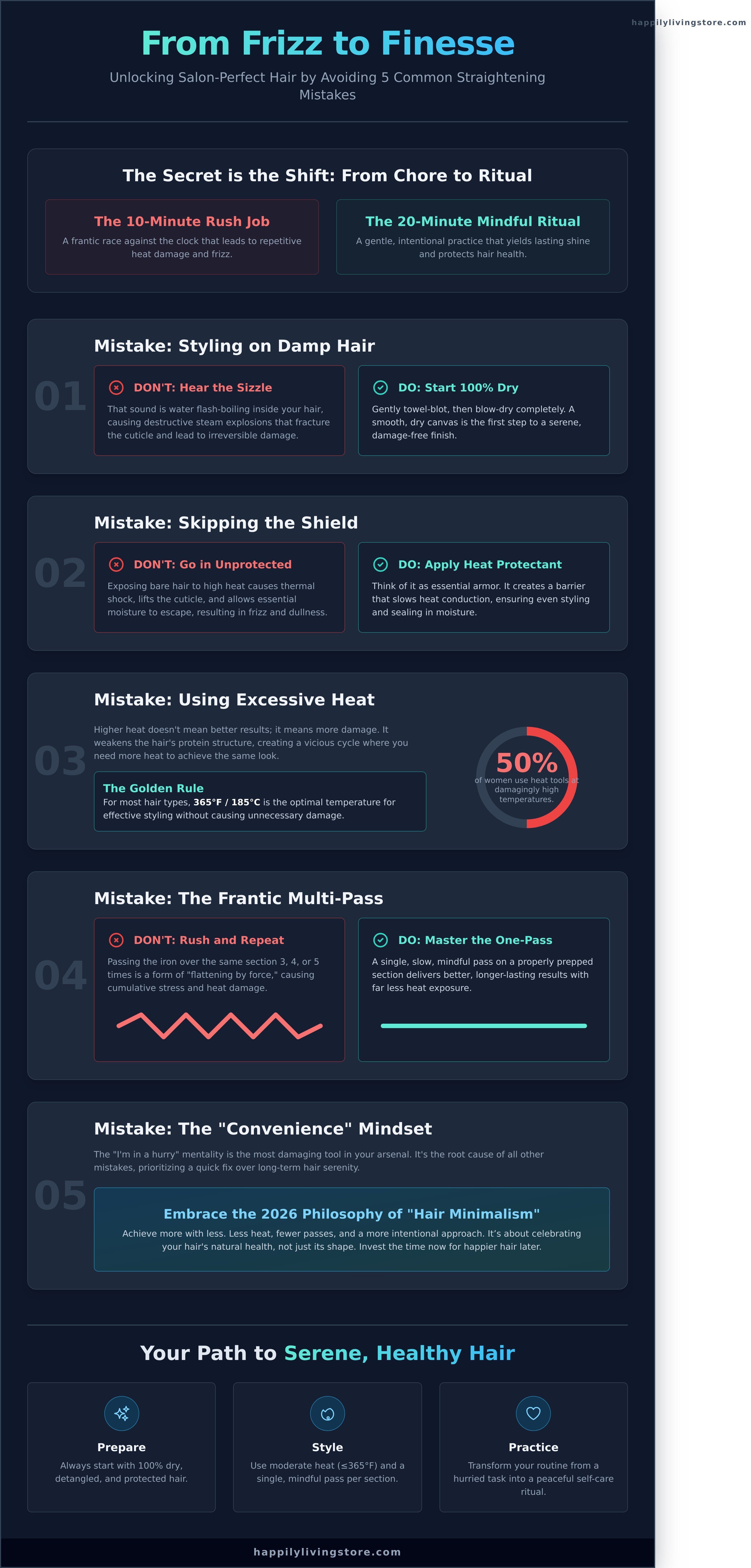
This is where the distinction between 'flattening' and 'styling' truly comes to life. Flattening is about force. Styling is about finesse. It's an understanding that the tools we use are part of a larger system of care. Modern hair straightening techniques have evolved significantly, yet our approach often remains rushed. We pass the iron over the same section three, four, maybe five times, hoping for a perfect finish, unknowingly causing layers of damage that become harder to manage over time.
This is why 2026 is poised to be the year of 'Hair Minimalism'. It’s a philosophy centered on achieving more with less. Less heat, fewer passes, and a more intentional approach. It’s about discovering that a single, slow, and mindful pass with your straightener on a properly prepped section of hair can deliver better, longer-lasting results than a frantic, high-heat rush job. It’s a return to celebrating the natural beauty and health of your hair, not just its shape.
The Cost of Convenience: Why Quick Fixes Fail
The "I'm in a hurry" mindset is perhaps the most damaging tool in our beauty arsenal. Rushing leads to repetitive heat application on unprotected hair, creating a vicious cycle. A 2021 study found that 50% of women use heat tools at temperatures far above the recommended 365°F. This excessive heat weakens the hair, making it seem like you need more heat to get the same result next time. This is how a 10-minute rush slowly destroys your hair’s integrity, turning styling into a battle instead of a joy.
Transitioning from a chaotic 10-minute session to a peaceful 20-minute ritual isn't about losing time; it’s about investing it in yourself and your hair's future. By slowing down, you give your hair the gentle attention it deserves, turning a frantic task into a moment of genuine self-care. This foundational shift in mindset is crucial, because all the other hair straightening mistakes we'll explore stem from this very same place of haste over health.
This principle of choosing health over haste applies to more than just our hair. Prioritizing our long-term wellness through preventive care is a powerful form of self-investment. For those interested in taking a proactive approach to their physical well-being, you can learn more about Health Screen Test.
Preparation Pitfalls: The Mistakes You Make Before the Iron Touches Your Hair
The journey to sleek, serene hair doesn’t begin with the flat iron. It starts much earlier, in the quiet moments after you step out of the shower. Creating a beautiful result is a ritual, and like any thoughtful practice, the foundation you build determines the outcome. The most common hair straightening mistakes often happen before a hot tool is even plugged in, turning a moment of self-care into a source of stress and damage.
Have you ever heard that dreaded sizzle? That sharp, startling sound as the iron clamps down is a cry for help from your hair. It’s the sound of water flash-boiling within the hair shaft, creating tiny, destructive steam explosions that fracture the cuticle. This is the cardinal sin of heat styling, and it's entirely preventable. The damage begins even earlier, with harsh towel-drying. Vigorously rubbing your hair with a coarse cotton towel creates friction that lifts and tears the delicate cuticle layer, inviting frizz and breakage before you’ve even reached for the blow-dryer.
The Essential Role of Heat Protectants
Think of a heat protectant not as an optional product, but as an essential shield for your strands. These thoughtful formulas typically use polymers, like silicones, to create a protective barrier on the hair’s surface. This barrier doesn’t block heat, but it slows down heat conduction, allowing for a more even distribution of warmth and reducing thermal shock. To apply it, section your hair and mist evenly from about six inches away, ensuring every strand is lightly coated but not saturated. It’s also vital to choose your products with care; the FDA has reported on the dangers of formaldehyde in hair products used in some salon treatments, reminding us to always be mindful of ingredients.
- Sprays: Lightweight and ideal for fine to normal hair, they provide an even, barely-there coating.
- Creams: A wonderful choice for thick, coarse, or dry hair, offering moisture along with protection.
- Oils: Typically best as a finishing touch for shine, though some are specifically formulated for heat protection on very dry hair.
Drying Techniques for a Smooth Foundation
Your blow-drying technique is what transforms damp hair into a smooth, straight-ready canvas. Always point the nozzle of your dryer downward, following your brush from root to tip. This simple directional change encourages the hair cuticles to lie flat, creating a naturally sleek and reflective surface. Once a section is dry, use the 'cool shot' button for a few seconds. This blast of cool air locks the smoothed cuticle in place, setting your work and adding a lasting polish.
Finally, patience is your greatest tool. Your hair must be 100% bone-dry before straightening. Not 95% or “mostly” dry. Even a hint of moisture can turn into damaging steam under the intense heat of a flat iron, which can easily reach 450°F (232°C). Taking an extra five minutes to ensure your hair is completely dry is one of the most important hair straightening mistakes you can avoid. Creating this perfect foundation begins with the right tools. We invite you to discover our collection of thoughtful hair care essentials designed to turn your daily routine into a moment of joy.
Technique Errors: Why One Pass is Better Than Ten
Imagine your hair styling routine not as a frantic race against the clock, but as a thoughtful, serene ritual. The difference often lies in technique. Many of us, in a hurry, pass the flat iron over the same section of hair five, six, even ten times, hoping to force it into submission. This is one of the most damaging hair straightening mistakes you can make. The secret to a happily sleek finish isn't more heat or more passes; it's more intention. By mastering a few key techniques, you can achieve a flawless look with a single, gentle glide, preserving the health and joy of your hair.
The "one-pass method" is exactly what it sounds like: a slow, deliberate pass over a well-prepared section of hair. Instead of a quick, sizzling motion, you glide the straightener from root to tip at a steady pace. Think of it like ironing a delicate silk blouse. You wouldn't aggressively press the iron back and forth. You use controlled, even movement. This method allows the heat to penetrate the hair shaft evenly, straightening it effectively in one go and reducing its total exposure to damaging temperatures by up to 80%.
Mastering the Art of Sectioning
Randomly grabbing large chunks of hair is a recipe for an uneven finish and heat damage. Some strands get scorched while others remain untouched, forcing you to go back over the section repeatedly. Create a moment of calm and order by sectioning your hair first. For most, the four-section rule is a perfect start: part your hair down the middle, then from ear to ear, creating four manageable quadrants. Use clips to keep the unused sections neatly tucked away, transforming a chaotic process into a peaceful one.
Temperature Control: Finding Your Hair's Sweet Spot
Instinctively cranking your straightener to its maximum 450°F setting is rarely the right answer. Your hair has a unique "sweet spot" where it styles effectively without being scorched. Finding this balance is crucial, just as it's critical to ensure your hair is perfectly prepped before heat touches it. Applying a straightener to hair still damp from product can cause irreversible steam damage; in fact, a dermatologist warns against this common mistake, emphasizing the need for a fully dry canvas. Discover your ideal temperature with this guide:
- Fine, fragile, or color-treated hair: 290°F - 350°F
- Normal, healthy hair: 350°F - 390°F
- Thick or coarse hair: 390°F - 410°F
How do you know if the heat is too low? If one slow pass isn't effective, you may need to increase the temperature by 10-degree increments. The goal is to find the lowest effective temperature for a single, perfect pass.
Finally, let's talk about pressure. You don't need to squeeze the plates together with force. Let the heat do the work. Gentle tension is what you need, and the best way to achieve this is with the "comb-chase" technique. Take a one-inch section of hair and run a fine-tooth, heat-resistant comb through it. Immediately follow, or "chase," the comb down the hair shaft with your straightener. This simple step detangles, creates even tension, and distributes each strand perfectly between the plates for a truly flawless, salon-quality glide. It's one of those small, thoughtful details that elevates the entire experience.
Tool and Aftercare Oversight: The Hidden Culprits of Frizz
You’ve artfully sectioned, patiently passed the flat iron through each strand, and created a beautifully sleek look. But within an hour, a halo of frizz begins to appear. It's a frustrating outcome, and the reason often lies not in your technique, but in the subtle details you might overlook. The tools you choose and the way you care for your hair immediately after styling are the hidden culprits behind a style that doesn't last. Avoiding these final-step hair straightening mistakes is the key to achieving a truly serene and lasting finish.
Your journey to sleek hair is a ritual, and every element of that ritual deserves thoughtful consideration. From the material of your styling plates to the final mist of hairspray, these small choices collectively determine whether your hair remains happily smooth or surrenders to humidity.
Investing in Quality: Ceramic vs. Titanium Plates
All flat irons are not created equal. The material of the plates directly impacts your hair’s health and the quality of your results. Think of it as choosing the right cookware for a delicate sauce; the material matters immensely.
This focus on quality and technology isn't limited to the tools themselves. The innovative brands that bring us these products also invest heavily in their digital storefronts, often partnering with expert web development agencies like Xell Technology to create the seamless online experiences where we discover and purchase them.
- Ceramic Plates: A truly gentle choice, ceramic is beloved for its ability to distribute heat evenly, minimizing the risk of hot spots that can scorch fine or color-treated hair. Most high-quality ceramic irons operate effectively between 300°F and 410°F, making them a safe and thoughtful option for creating your daily look at home.
- Titanium Plates: For those with coarse, thick, or particularly stubborn hair, titanium is a powerful ally. It transfers heat more rapidly and can reach higher temperatures, often up to 450°F, providing a quick and effective straighten. This power requires a mindful touch to prevent damage.
Regardless of the material, look for a tool infused with ionic technology. A 2021 study published in the Journal of Cosmetic Science confirmed that ionic hair tools can reduce static and frizz by up to 75% by emitting negative ions that neutralize the hair's positive charge. This single feature is essential for achieving that happily smooth, flyaway-free finish. Don't forget the importance of clean plates. Product buildup from heat protectants can bake onto the surface, creating friction that snags and breaks delicate strands. A simple ritual of wiping the cool plates with a damp cloth after every 5-7 uses preserves both your tool and your hair. Discover our curated collection of thoughtfully designed hair tools to elevate your styling sanctuary.
The Finishing Touch: Choosing Thoughtful Products
The final products you apply can either seal your sleek style or sabotage it. One of the most common hair straightening mistakes is reaching for a finishing product that works against your hair. Heavy, silicone-based serums, for example, can feel silky at first. However, certain silicones like dimethicone are occlusive and can attract moisture from humid air, ironically causing the hair cuticle to swell and frizz.
Perform the 'Alcohol Check' on your hairsprays and finishing mists. Look for drying agents high on the ingredient list, such as alcohol denat, isopropyl alcohol, or SD alcohol 40. These ingredients can strip your hair's natural moisture, leaving the cuticle rough and thirsty. Instead, seek out formulas with moisturizing fatty alcohols like cetyl or stearyl alcohol.
For a truly mindful finish, warm a single drop of a natural oil, like argan or jojoba, between your palms and gently press it onto the ends of your hair. This seals the cuticle without adding weight. Finally, grant your hair a moment of stillness. Let it cool completely for at least 10-15 minutes before stepping outside. Rushing out while your hair is still warm invites cool or humid air to create instant frizz, undoing all your careful work.
Elevating Your Ritual: How to Straighten Hair Happily and Healthily
Transforming your hair can be more than a routine; it can be a cherished ritual. It’s a quiet moment carved out just for you, a practice of patience and care. Instead of rushing through the motions, we invite you to slow down and rediscover the joy in the process. By shifting your perspective, you leave behind the anxiety of making common hair straightening mistakes and step into a space of mindful beauty. Let's create a sanctuary where every glide of the iron is an act of self-love.
We believe in a simple, five-step ritual for achieving that salon-perfect finish with peace and intention:
- Step 1: Create Your Haven. Before you begin, prepare your space. Light a favorite candle, play some calming music, and lay out your tools on a soft towel. This isn't a chore; it's your time.
- Step 2: Prep with Kindness. After gently towel-drying your hair, apply a high-quality heat protectant from roots to ends. Think of it as a nourishing shield for your beautiful strands.
- Step 3: Section with Purpose. Divide your hair into manageable one-to-two-inch sections. Working slowly and methodically ensures every strand receives even, gentle heat.
- Step 4: The Art of the Glide. This is the heart of the ritual. With our Professional Hair Straightener, you don’t need to rush. Its ceramic plates distribute heat evenly, allowing for a single, graceful pass from root to tip. Feel the smooth, effortless glide.
- Step 5: Set and Admire. Once your hair has cooled for a few minutes, apply a lightweight finishing serum to seal in the shine. Take a moment to appreciate the silky, healthy result of your mindful work.
The 3-Day Style Preservation Strategy
True slow living means making beautiful moments last. With a few thoughtful habits, you can extend the life of your sleek style for up to three days, reducing heat exposure and saving precious time. Sleep on a silk or satin pillowcase to reduce overnight friction by nearly 40% compared to traditional cotton, preventing frizz and breakage. On day two, revive your roots with a targeted spray of dry shampoo from 6 inches away, then massage it in to restore volume and freshness. For touch-ups, address only the sections that truly need it, like the hairline or a few flyaways on top.
A Final Invitation to Slow Living
By turning your routine into a ritual, you move beyond simply avoiding hair straightening mistakes; you begin a practice of intentional self-care. It’s a celebration of your own unique beauty, a quiet conversation with yourself in the mirror. We encourage you to enjoy your reflection not just for the result, but for the peaceful journey you took to create it. Your hair is an expression of you, and caring for it should bring you nothing but joy.
This same spirit of celebrating beauty can extend from personal rituals to exploring the natural world. If you're inspired by new journeys, you can discover Cozumeldivehub and the breathtaking underwater world it introduces.
This spirit of turning routine into a celebrated, beautiful journey isn't just for our daily lives. For those inspired to take that feeling of discovery further, you can discover Sola Travel and explore tours through Egypt, a land famous for its ancient beauty rituals.
Ready to transform your routine into a ritual? Discover our Professional Hair Straightener for a gentler, more beautiful glide.
Embrace Your Hair's Serenity
Your journey to sleek, healthy hair isn't about fighting it into submission; it's about creating a moment of gentle care. True hair happiness begins before the heat is even on, with a foundation of fully dry hair and a nourishing heat protectant. Remembering that a single, mindful pass is far kinder than ten hurried ones transforms your entire approach. By consciously avoiding these common hair straightening mistakes, you're not just styling your hair; you're honoring it.
It's time to elevate this daily moment. Our Professional Hair Straightener was designed for this very purpose. Its Advanced Ionic Technology releases over 20 million negative ions to seal the cuticle, delivering a frizz-free shine that feels as serene as it looks. With 11 precise temperature settings from 265°F to 450°F, you can find the perfect, gentle heat for your unique hair type, while the stress-free, ergonomic design turns the process into a calming ritual. Create your hair sanctuary with our Professional Hair Straightener.
Discover the joy in the process and let your hair reflect the peace you cultivate. Here's to styling, happily.
Frequently Asked Questions About Hair Straightening
Is it okay to straighten my hair every day if I use a protectant?
No, it's best to avoid straightening your hair every day, even with a heat protectant. Daily heat can still cause cumulative damage, leading to dryness and breakage over time. While a heat protectant is an essential shield, it isn't completely impenetrable. Aim to give your hair at least 2-3 rest days per week to maintain its natural moisture and strength. This small ritual of patience helps preserve your hair’s long-term health and shine.
What temperature should I set my flat iron to for fine hair?
For fine or color-treated hair, you should set your flat iron between 250-300°F (120-150°C). Higher temperatures can scorch these delicate strands, causing irreversible damage. A 2011 study in the Journal of Cosmetic Science confirmed that temperatures above 347°F (175°C) begin to degrade the hair's keratin protein. A gentle, mindful approach with lower heat will give you the sleek results you desire without compromising your hair's integrity.
Why does my hair smell burnt even when I use a heat protectant?
A burnt smell often indicates your heat setting is too high or there's product buildup on your flat iron's plates. Even with a protectant, excessive heat can singe the hair cuticle. Additionally, leftover styling products on your iron can burn, transferring that scent to your hair. Try lowering the temperature by 20-30°F and ensure your plates are perfectly clean before each use. This thoughtful step can transform your styling routine into a more serene experience.
Can I use a flat iron on hair with styling products already in it?
You should only use a flat iron on hair after applying a heat protectant, not with other styling products like hairspray or mousse. Many styling products contain alcohols and polymers that are not designed for high heat; they can melt onto your hair and the iron, causing stickiness and damage. Always straighten clean, dry hair with only a dedicated heat protectant applied, creating the perfect canvas for your final, beautiful style.
How do I know if my hair straightener is damaging my hair?
Telltale signs of heat damage include increased split ends, a rough or straw-like texture, and hair that appears dull or lacks its usual shine. You might also notice your hair becoming more frizzy or difficult to manage. One of the most common hair straightening mistakes is ignoring these early warnings. If you see these changes, it’s a gentle cue from your hair to reduce heat styling and incorporate a weekly deep conditioning treatment to restore moisture.
What is the 'Comb-Chase' method and does it really work?
The 'Comb-Chase' method involves running a fine-tooth comb through a section of hair immediately ahead of the flat iron, and yes, it works very well. This technique ensures each strand is detangled and evenly distributed as it passes through the plates, resulting in a sleeker finish with fewer passes. According to celebrity hairstylists like Jen Atkin, this method significantly reduces frizz and helps achieve salon-quality results at home, turning a simple step into a mindful ritual.
Should I use oil before or after straightening my hair?
You should always apply hair oil after straightening, never before. Applying oil before using a flat iron can essentially "fry" your hair, as the oil heats to extreme temperatures on the hair shaft. This is one of the more damaging hair straightening mistakes you can make. A lightweight finishing oil applied afterward will seal the cuticle, add a beautiful shine, and tame flyaways without causing heat damage. Think of it as the final, loving touch to your styling ritual.
How often should I clean the plates of my hair straightener?
For optimal performance and hair health, you should clean the plates of your hair straightener at least once a week if you use it regularly. Product buildup from heat protectants and natural hair oils can cause uneven heating and snagging. To clean, ensure the iron is unplugged and completely cool. Then, gently wipe the plates with a soft cloth dampened with a 50/50 solution of water and rubbing alcohol. This simple act of care ensures your tool works beautifully.